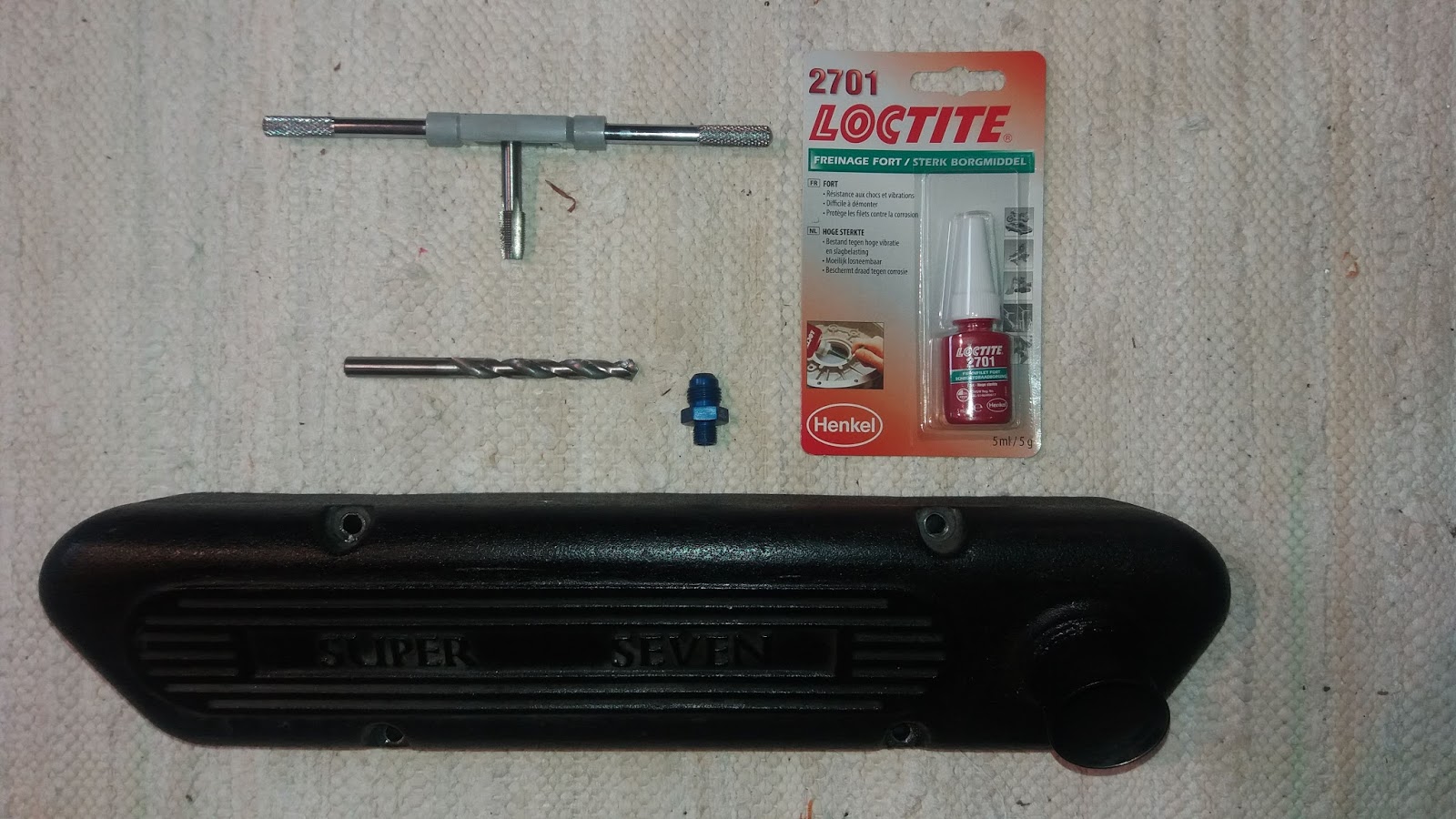
With a whole day off, I wanted to do as much as possible. Started with an easy one, a plug I turned out of brass and which I bonded to the mechanical odometer outlet from the gearbox. With the electronic dash, I will not need it anymore, so I closed it to prevent it spilling oil.
As already fixed to the right side, this is the sibling rail on the driver's side helping to fix the side panel.
This is the aluminium panel behind the seats. The original panel didn't come out easily and I had to bend it too much to save it. So this is the newly made panel (2mm aluminium) which will be covered with fleece.
In above showed panel, you can see four big holes to allow access to some of the suspension bolts. This handy tool allows to cut them easily into all kinds of material.
Cheers.
Monday, May 28, 2012
Thursday, May 24, 2012
Back back on
After a lot of preparation work, the new back panel is on ! Mounting alone took three hours. The panel being readily bent, cut and drilled, I applied Sicaflex on the chassis rails. Immediately after bonding the panel to the chassis, I riveted it on three spots every side while the clamps kept it in place. Then I bent the upper border of the panel over the top chassis rail. I did it in separate sections, but this will not be seen later. The whole border will be covered by patent leather.
Cheers.
Monday, May 21, 2012
Trip to the isle
Another scale model purchased in Faversham (Kent) during street trading. Lots of 1:1 classic cars displayed as well, so many I could fill a separate blog with the pics I took.
This is another scale model of the Caterham R500 Superlight from Matchbox (with some Corgi collector's in the background).
Cheers.
This is another scale model of the Caterham R500 Superlight from Matchbox (with some Corgi collector's in the background).
Cheers.
Sunday, May 13, 2012
Engine compartment
First panel inside the engine compartment, this panel will hold some of the electrical equipment. Also visible, the aluminium rail and it's spacers screwed and glued (Sicaflex) to the chassis rail. This rail will support the front part of the side panel. This panel has to be a little bit higher to suit the Caterham nose and bonnet.
Cheers.
Cheers.
Saturday, May 12, 2012
Rear body panel
Finally ... after much trying and preparation, I manufactured the rear body panel.
From top: first bend, preparing second bend, second bend, cutting the edges, front & rear view.
Starting from a 200x100cm aluminium panel 1,5mm thick, I cut a piece of 200x60cm. The bends are 79cm distant which leaves some sheet to be cut. The panel now has to be adapted to the chassis. This means cutting it to it's precise shape, riveting and bonding it to the rails and then bending the top over the top rail.
Cheers.
From top: first bend, preparing second bend, second bend, cutting the edges, front & rear view.
Starting from a 200x100cm aluminium panel 1,5mm thick, I cut a piece of 200x60cm. The bends are 79cm distant which leaves some sheet to be cut. The panel now has to be adapted to the chassis. This means cutting it to it's precise shape, riveting and bonding it to the rails and then bending the top over the top rail.
Cheers.
Oil temperature sensor
As described below, one of the plates of the new oilpump will be used to plug the oil temperature sensor in. This is a Stack sensor (ST764) and it will be electrically connected to the Stack dash.
Cheers.
Cheers.
Friday, May 11, 2012
Oilpump knowledge
More oilpump knowledge thanks to 'supernono' (that's his nick in the french sevener forum) who had the sump off his engine and had a look for me where all the lines and channels go from and come to the pump. Valuable details I thankfully add to my blog to share with everybody interested.
The Pace wet sump oilpump has two blanking plates. Those plates can be replaced by connectors to loop in an oil cooler. As I want to run the engine without such a cooler, I can use one of the plates to mount the oil temperature sender for the Stack gauge. The thread is 1/8x27 NPT and is easily cut into the aluminium. You may notice that the fitting is not in the middle of the plate. This is due to the channel inside the pump having a slight angle.
Cheers.
Wednesday, May 9, 2012
Oilpump résumé
After my initial hesitation about the new oilpump, I decided to further dig the subject. Surfing the web and reading lots of forum threads, one thing became clear: there are a lot of different pumps "out there". The engine in my car being a X-flow, you must know that there was the pre-xflow as well. Then there are the original Ford pumps, side-driven with or without angle. To add to the confusion, you can also find front-driven pumps, separate or integrated into the engine front cover. And to top it off, you can choose between dry sump and wet sump systems with according pumps.
Search criteria for me were 'side-driven' and 'wet sump'. I found three different pumps, but there might be more. A lot of small specialized companies developed and build their own. Since this engine has been on the market for several decades, there are a lot of different pumps both old and new.
Ford Burman Oil Pump (used, 50.-£ at Historic Racing)
Neil Bold Filter Type Pump (around 335.-£ + VAT at Historic Racing)
Pace DSP5 (around 250.-£ including VAT at Burton Power)
For the techies amongst you ...
... and finally, this one I really adore. The guys at Throbnozzle Racing apparently sent this to Pace to explain what kind of pump they imagined best for the Ford Kent X-flow.
Cheers.
Monday, May 7, 2012
Engine mount mod
The Pace oil pump has connector plates to allow the use of an oil cooler without the need of a sandwich plate. Unfortunately on my car, the upper plate collidse with the engine mount.
This meant, lifting the engine, unmount the bracket, saw, file, try, saw, file, try ... until there was enough place to mount the pump. Later, I will use one of the plates to connect the oil temperature sensor.
The Monza fuel filler mounted for good. The rising fuel price calls for a lockable insert.
Cheers.
This meant, lifting the engine, unmount the bracket, saw, file, try, saw, file, try ... until there was enough place to mount the pump. Later, I will use one of the plates to connect the oil temperature sensor.
The Monza fuel filler mounted for good. The rising fuel price calls for a lockable insert.
Cheers.
Sunday, May 6, 2012
Oilpump vs. oilpump
Pic shows the new Pace oilpump (left) and the old oilpump to compare. While the bolt pattern is the same, the internals are slightly different. I will post this pic in some of the forums prior to mount the new pump to be sure it suits my engine. Additionally, the new pump falls foul with the engine mount. But this is the lesser problem because I can modify it.
Oilpump connections on the engine will have to coincide with those of the new pump.
In case the brownies would decide to assemble the car one night, the battery should be ready, shouldn't it. This is a loading device you can leave on to take care of the battery by controlling the load and maintaining it.
Cheers.
Subscribe to:
Posts (Atom)